Dante Alighieri’s 'Inferno'


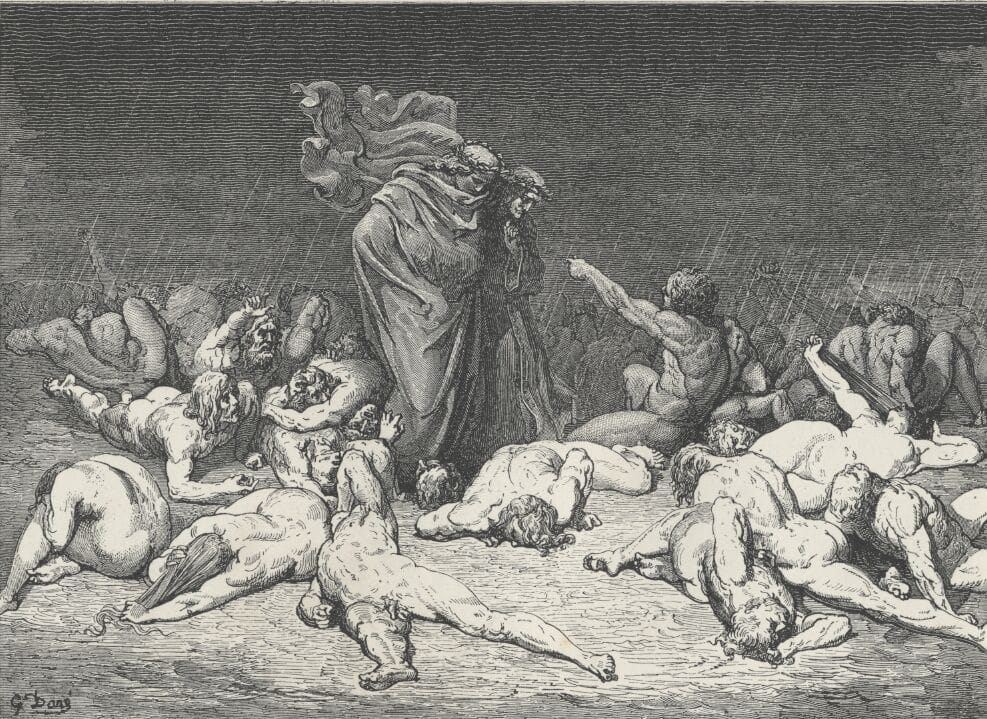
Dante’s Inferno is incomprehensible unless read as a drawn out poison pen letter. While some emphasize the implacable judgment of God, it has more to do with Dante’s own sense of betrayal and exile from his home city of Florence, to which he never returned. This is a tale of literary revenge upon the Florentines, full of picturesque tortures (medieval, not biblical). It is no coincidence that the deepest level of Hell (the 9th circle) is reserved for those who betrayed others, including Cain, for killing his brother Abel in Genesis 4 and, at furthest remove, Judas Iscariot in a zone called Judecca, for his betrayal of Christ. (Nietzsche agrees with me; Jorge Luis Borges does not.) The illustration below of Canto VI from Dante's Inferno is by Gustave Doré from the 1860's.
Dante’s choice of Judecca has a taint of anti-Semitism, which was not unusual for the time (early 1300’s) when the Jews were blamed for the death of Jesus. The Judecca (today’s Giudecca) is an island on the south side of central Venice, so named after the many Jews who settled there from the 1200’s onwards. They were obligated to live physically separated from the majority Christian population of the city – thus doubly exiled – at the time Dante was writing his Inferno. Throughout the century that followed, Jews began to live in Venice’s north-central area of Cannaregio, in what became the famous Venetian Ghetto, albeit still cut off by canals. By 1516 the approximately 700 Jews in Venice were not permitted to live anywhere else but there. The gates and restrictions only came down in 1797 with Napoleon's invasion.
Of course, Dante also damns Muslims to the Inferno, in Canto VIII with its burning mosques and XXVIII with Mohammed and Ali torn apart. While this was perhaps understandable when Christian Europe felt under threat, it also seems Dante would have supported another crusade to the Holy Land against Saracens and Jews (the last one petered out in 1291 with the fall of Acre). More Inferno here.
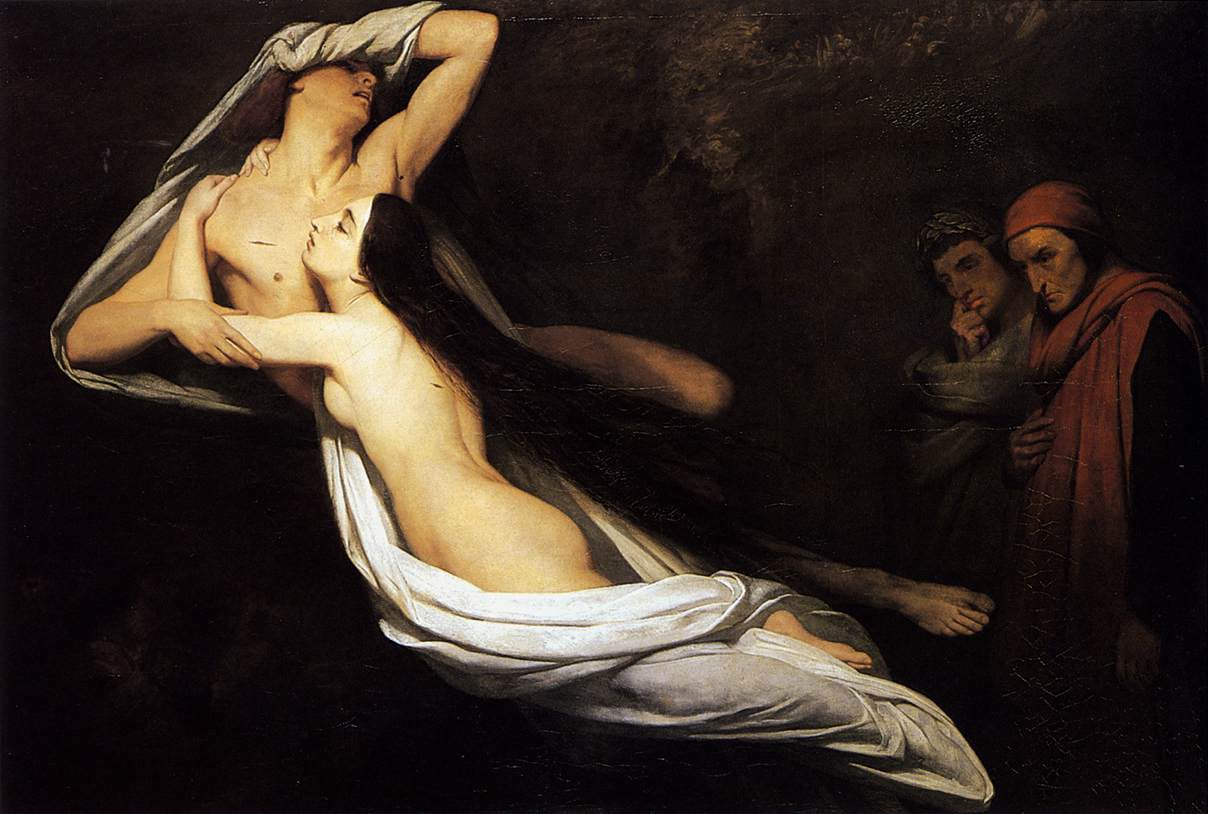
Above is The Ghosts of Paolo and Francesca Appear to Dante and Virgil by Ary Scheffer. The story of these doomed adulterous lovers inspired many. Keats wrote a poem to them in 1819; Tchaikovsky composed a symphonic poem to Francesca in 1876; Auguste Rodin sculpted The Kiss for them in 1889 - they are kissing each other "on the mouth, all trembling" - and Gabriele d'Annunzio wrote a play about Francesca with his lover Eleonora Duse in mind in 1901. Scheffer's painting reminds me of Zeffirelli's film Romeo and Juliet (1968).
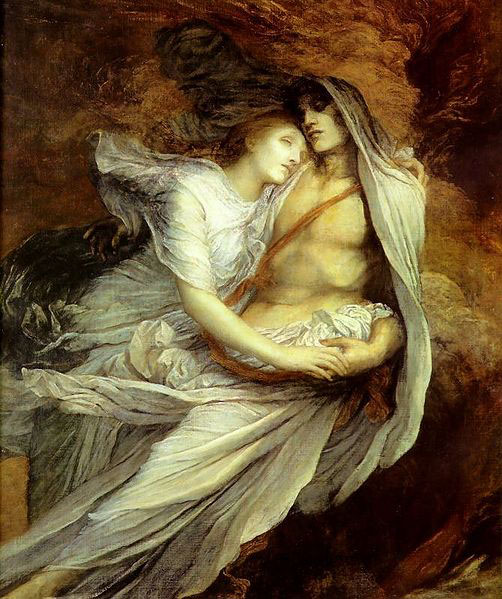
Was Dante envious that they knew love and he did not? Beatrice may not have even known who Dante was. Here is yet another version, Paolo and Francesca by George Frederic Watts, from the 1870's. It reminds me of Russian painter Mikhail Vrubel (here).