Sex Orgies as Pagan Fertility Rites


The sexual orgies Twain refers to were pagan fertility rites that were connected to planting seeds in the rich earth and the hoped-for harvest, but the orgies have faded away somewhat on the mechanized and commercial farms of today.
Back in ancient times there was an explicit recognition of the sacred role sex plays in preserving life in the face of famine and death. James Frazer’s The Golden Bough was the landmark study in this area. Published between 1890 and 1915, it describes life as an annual ritual of worship and sacrifice. The book influenced Twain and subsequent writers interested in myth, such as James Joyce, D.H. Lawrence, T.S. Eliot (who acknowledges it in The Waste Land, 1922) and Robert Graves (The White Goddess, 1948). Frazer’s most interesting (and controversial) argument was that Christianity was founded on the same fertility cults as all the other religions. For more on this and the Virgin Mary: here.
In the 19th century, Bouguereau was considered one of the most popular and commercially successful painters of all time, whose reputation was rewritten by the Impressionists. Although his paintings are in general mythological and sentimental, the work below, Dante and Virgil in Hell, from 1850, is striking for its homoeroticism. It is in the Musée d'Orsay and their website explains that this is a scene from the Eighth Circle of Hell, where a violent criminal and impersonator named Gianni Schicchi is attacking another man. One could easily make the case that Bouguereau's thoughts may have been in the Seventh Circle where the sodomites were to be found. But then we also know that Virgil himself likely was homosexual.
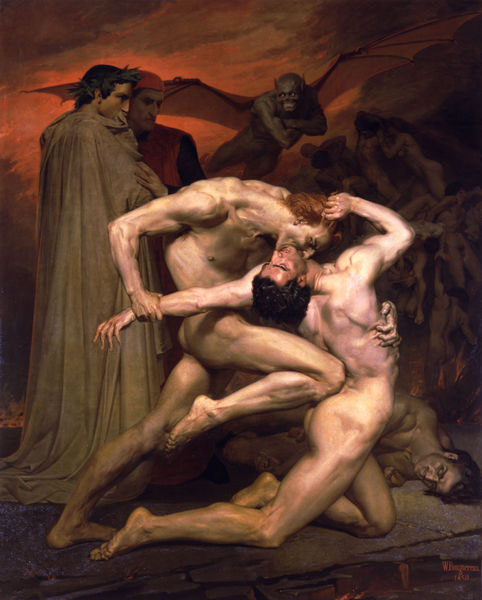
Below is an illustration that really is from the Seventh Circle. It is from a manuscript of Dante's Inferno from Pisa around 1327–28, and now in the Condé Museum, Chantilly.
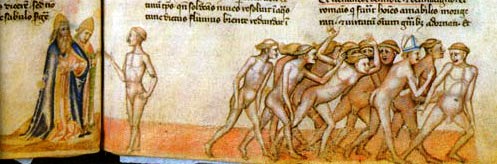
Although they appear to be enjoying themselves here, Dante took an extremely hostile view of homosexuality and sodomy. The Seventh Circle is near the bottom. Even his own beloved former guardian, Brunetto Latini (in the lower image, he is the man on his own addressing them), is condemned to stay here, moving around aimlessly with the rest, dodging the fiery flakes coming from the sky.
More Inferno here.